The ECVP is an annual international conference that aims to provide a forum for the presentation and discussion of new developments in the scientific study of visual perception. Empirical, theoretical, and applied perspectives from the disciplines of psychology, neuroscience, and cognitive science are all welcome and encouraged. Since 1978, ECVP has been one of the largest international conferences in the field, attracting researchers from all over the world.
General Information
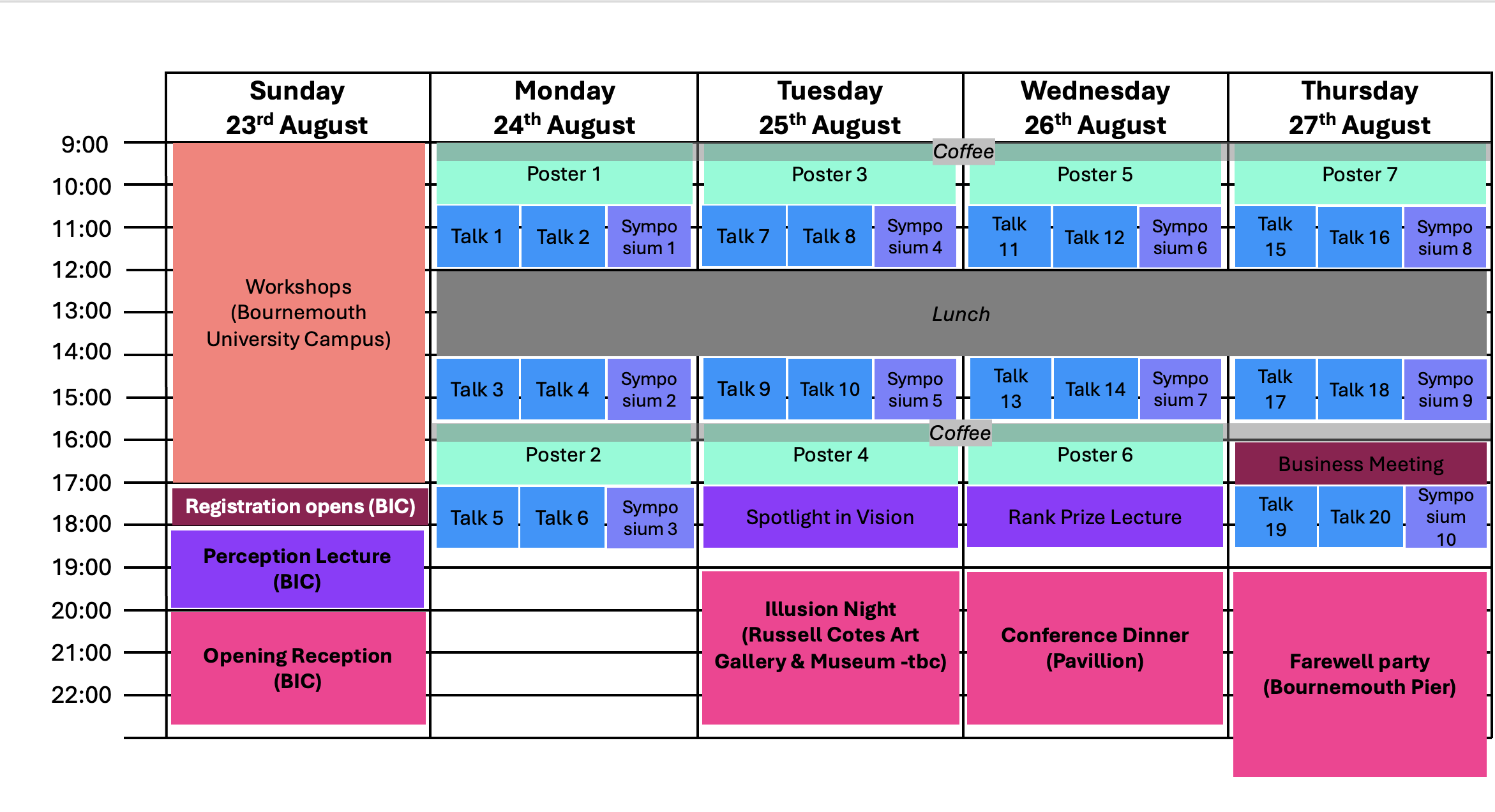
ECVP 2026 starts on Sunday, August 23th with a series of hands-on workshops and ends on Thursday, August 27th with the Farewell Party.
More information …
On Sunday, August 23rd, ECVP 2026 in Bournemouth will kick off with a series of workshops and that will take place on the University Campus in the morning and early afternoon. On Sunday evening, the Perception Keynote Lecture will be held by Karl Gegenfurtner (Justus Liebig University of Giessen) at the Bournemouth International Centre, followed by the Opening Reception.
From August 23th to August 27th, all symposia, talk sessions, poster sessions and keynote lectures will take place at the Bournemouth International Centre, in the city centre, by the sea.
On Tuesday afternoon (August 25th), we will continue the Spotlight Lecture series, which showcases recent innovative and influential findings or methods in vision science. In 2026 the Spotlight in Vision Lecture will be given by Nadine Dijkstra (University College London). In the evening, the popular Illusion Night will take place.
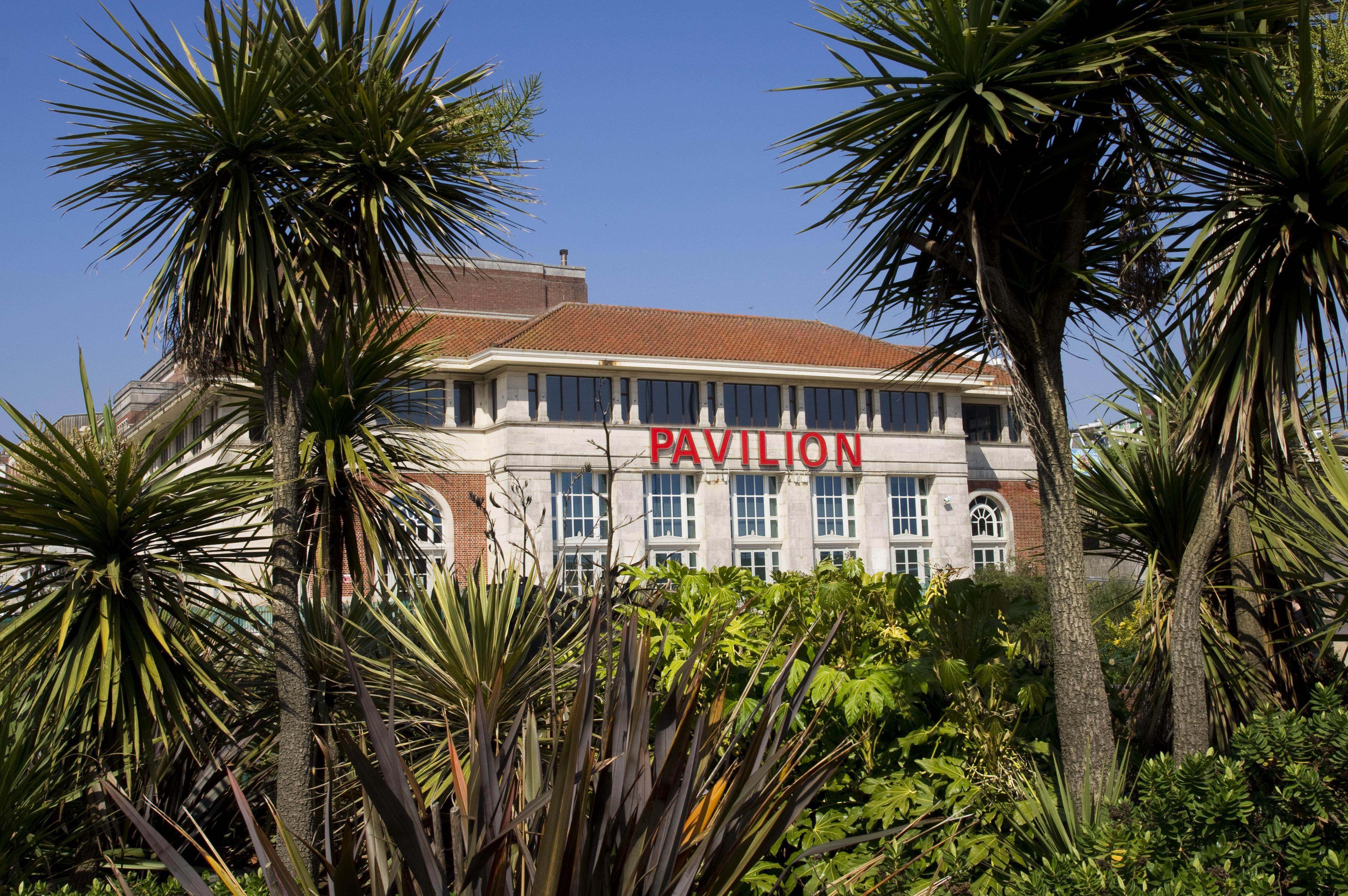
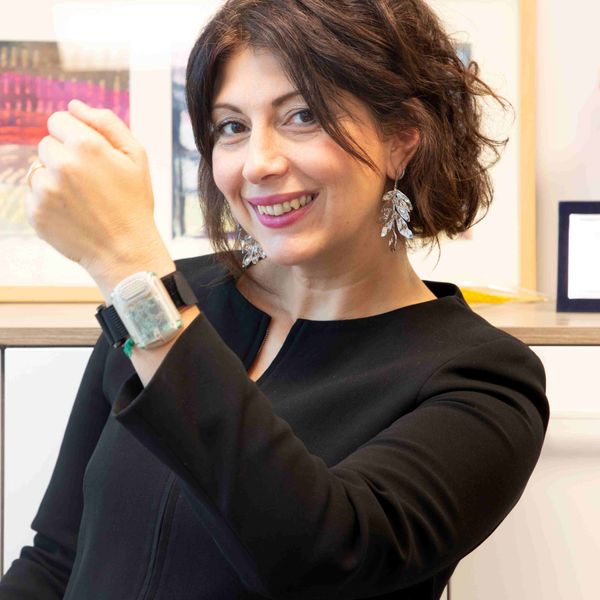
On Wednesday (August 26th), the traditional Rank Prize Lecture, this year given by Monica Gori (Istituto Italiano di Tecnologia), will take place in the afternoon, and the Conference Dinner will be held in the evening at the Pavillion.
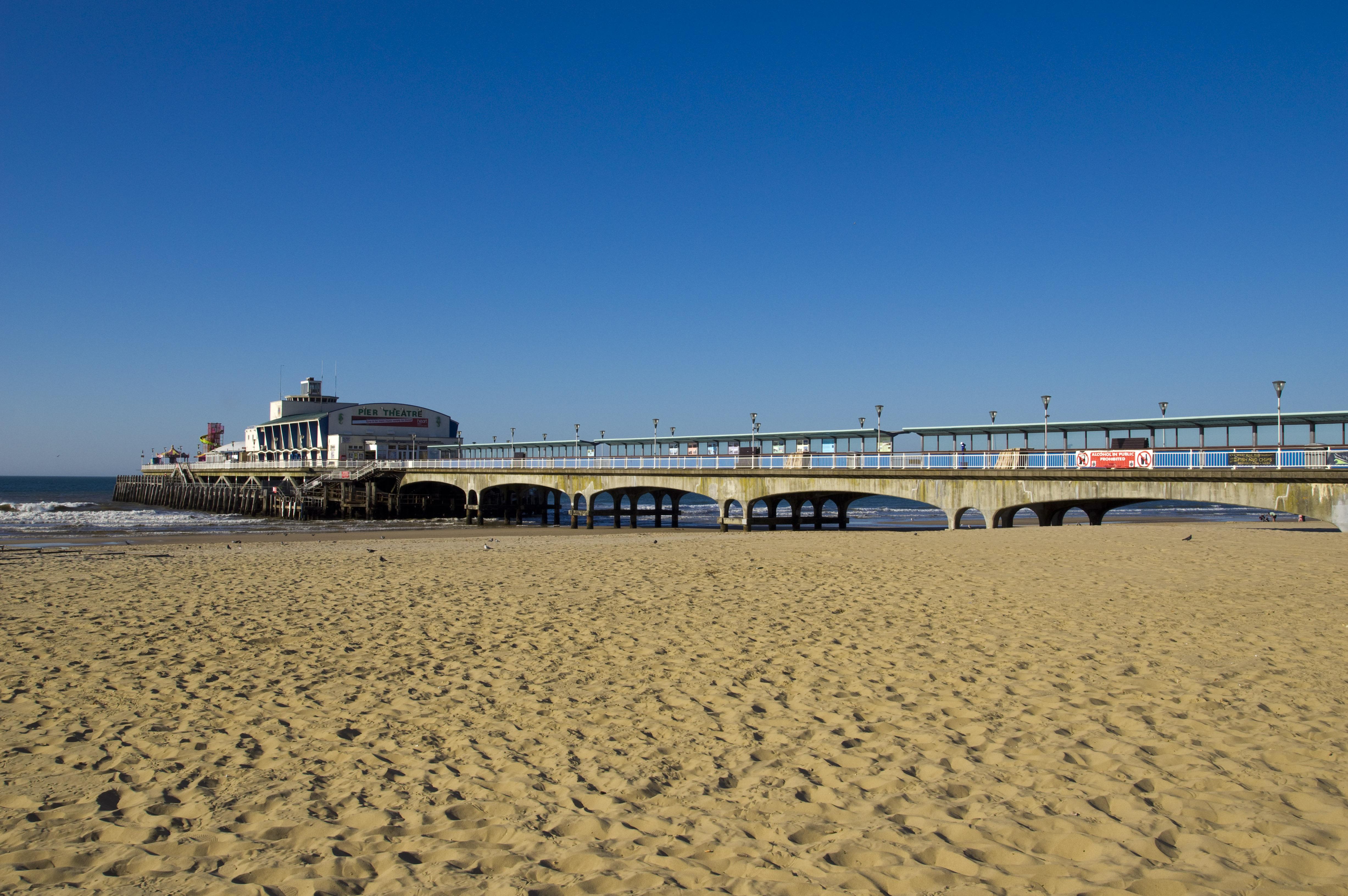
Finally, the conference will conclude on Thursday (August 27th) with talks and poster sessions running into the late afternoon. In the evening we will celebrate the end of the conference with the Farewell Party at the Bournemouth Pier, five minutes walk from the Bournemouth International Centre, litterally on the sea.
Bournemouth Interational Centre
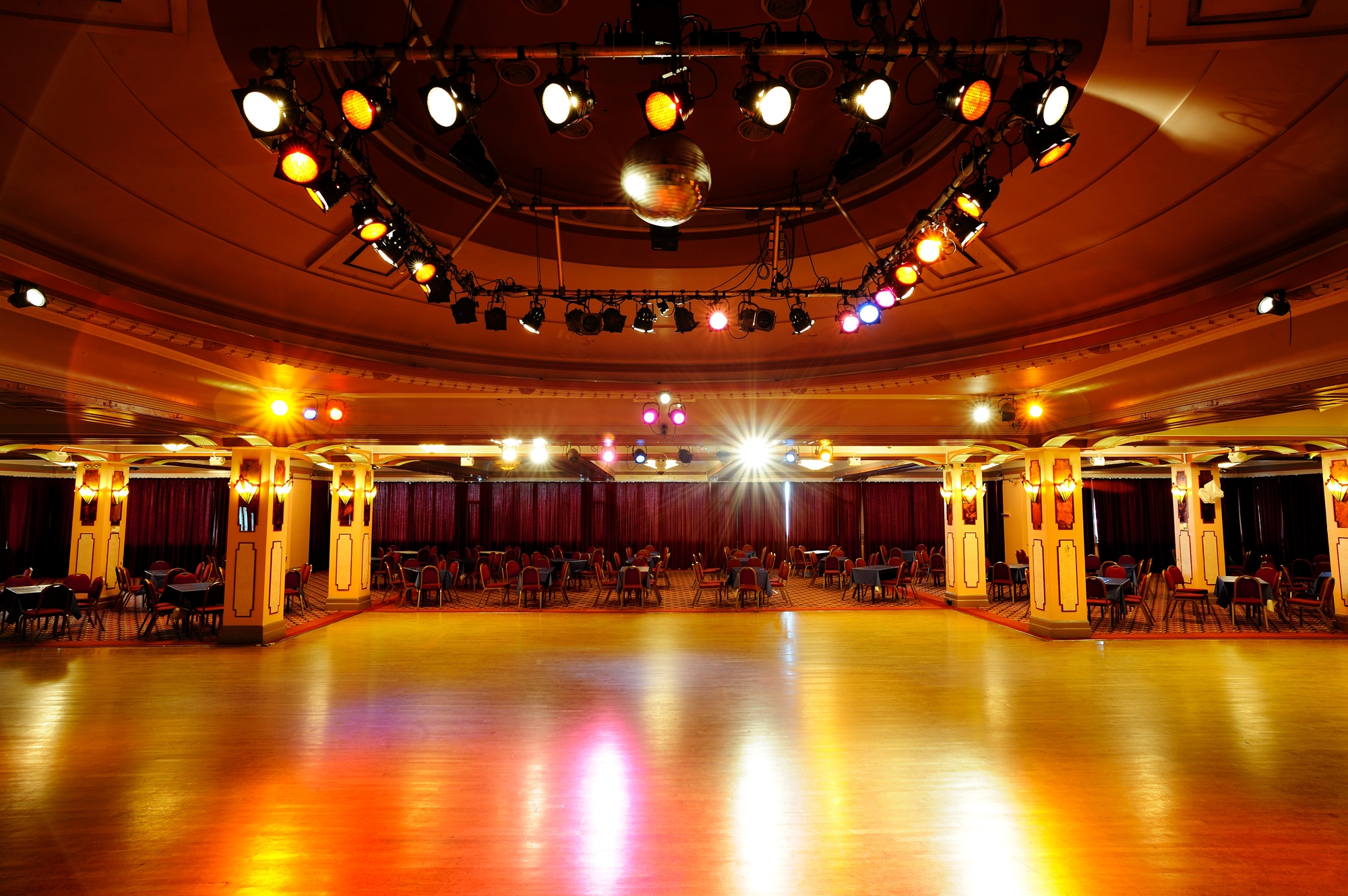
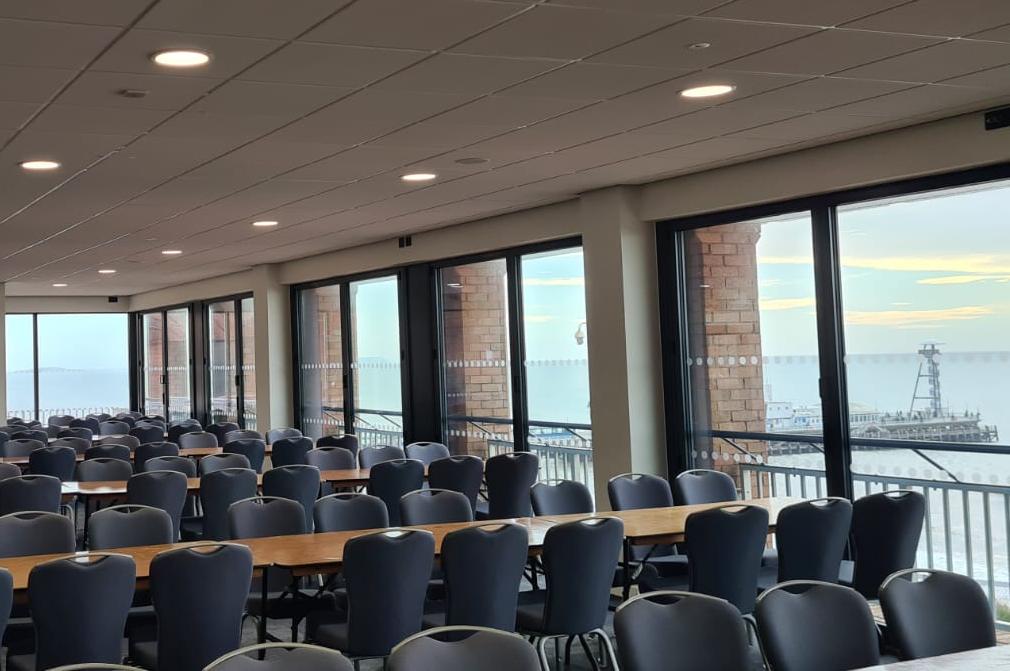
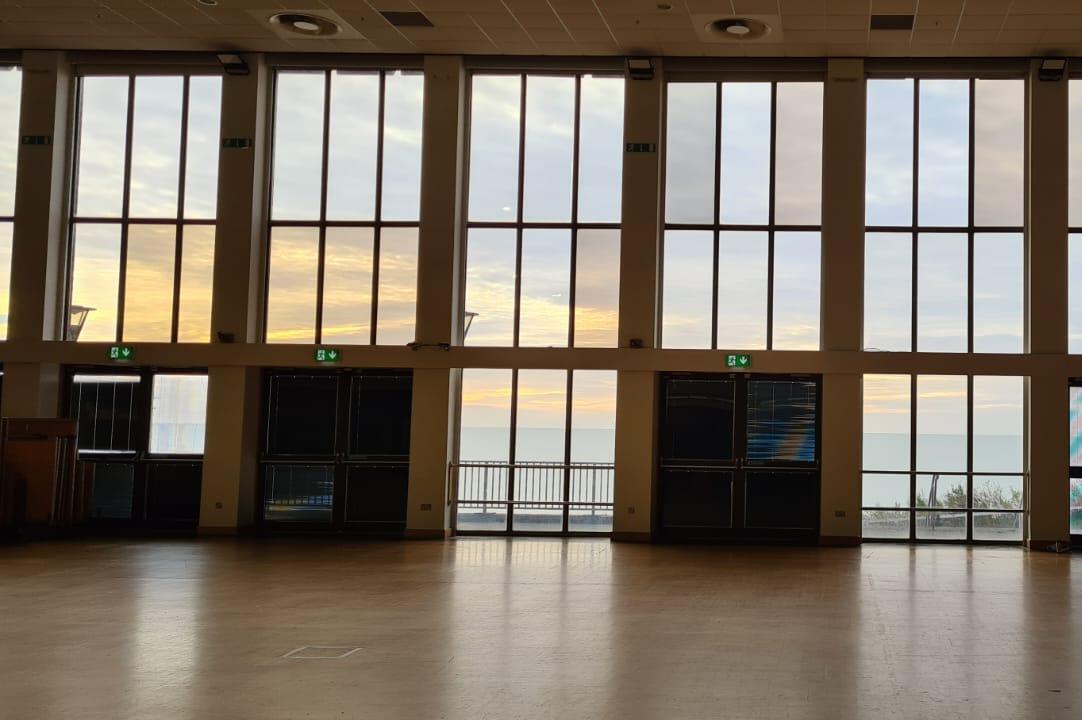
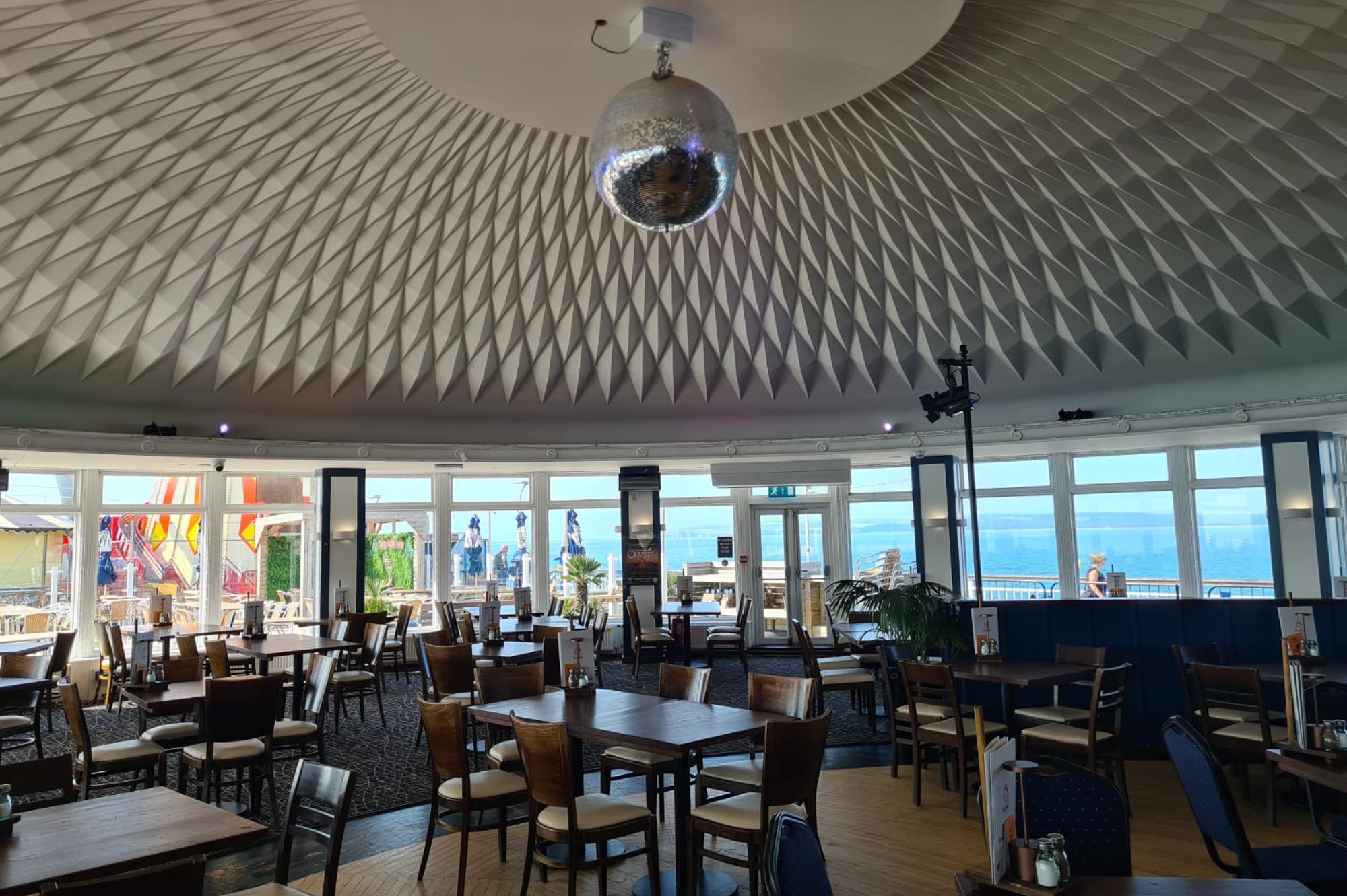
The main conference venue is the Bournemouth International Centre . It offers several conference rooms, some of which faceing the sea.
Russell Cotes Art Gallery & Museum
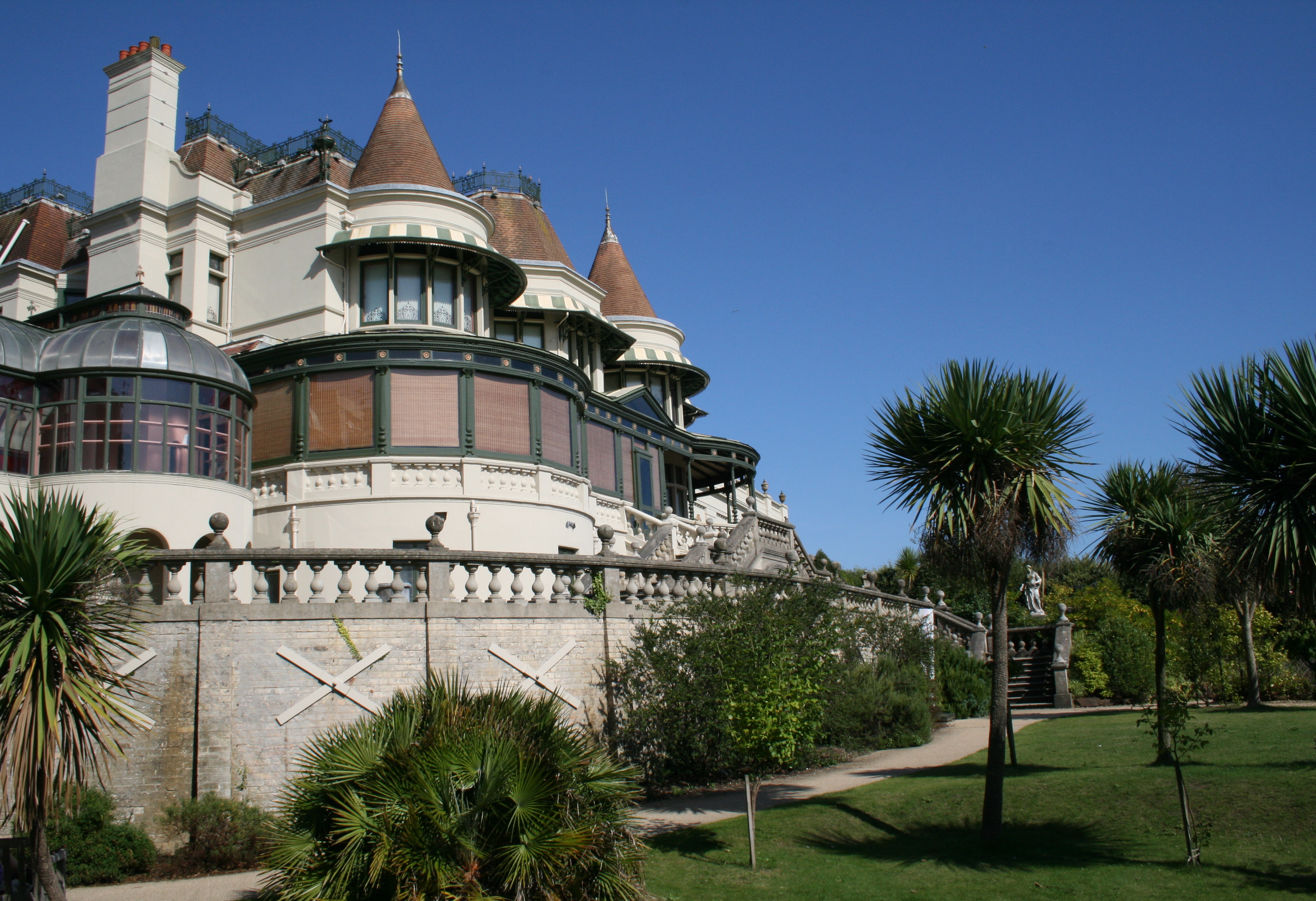
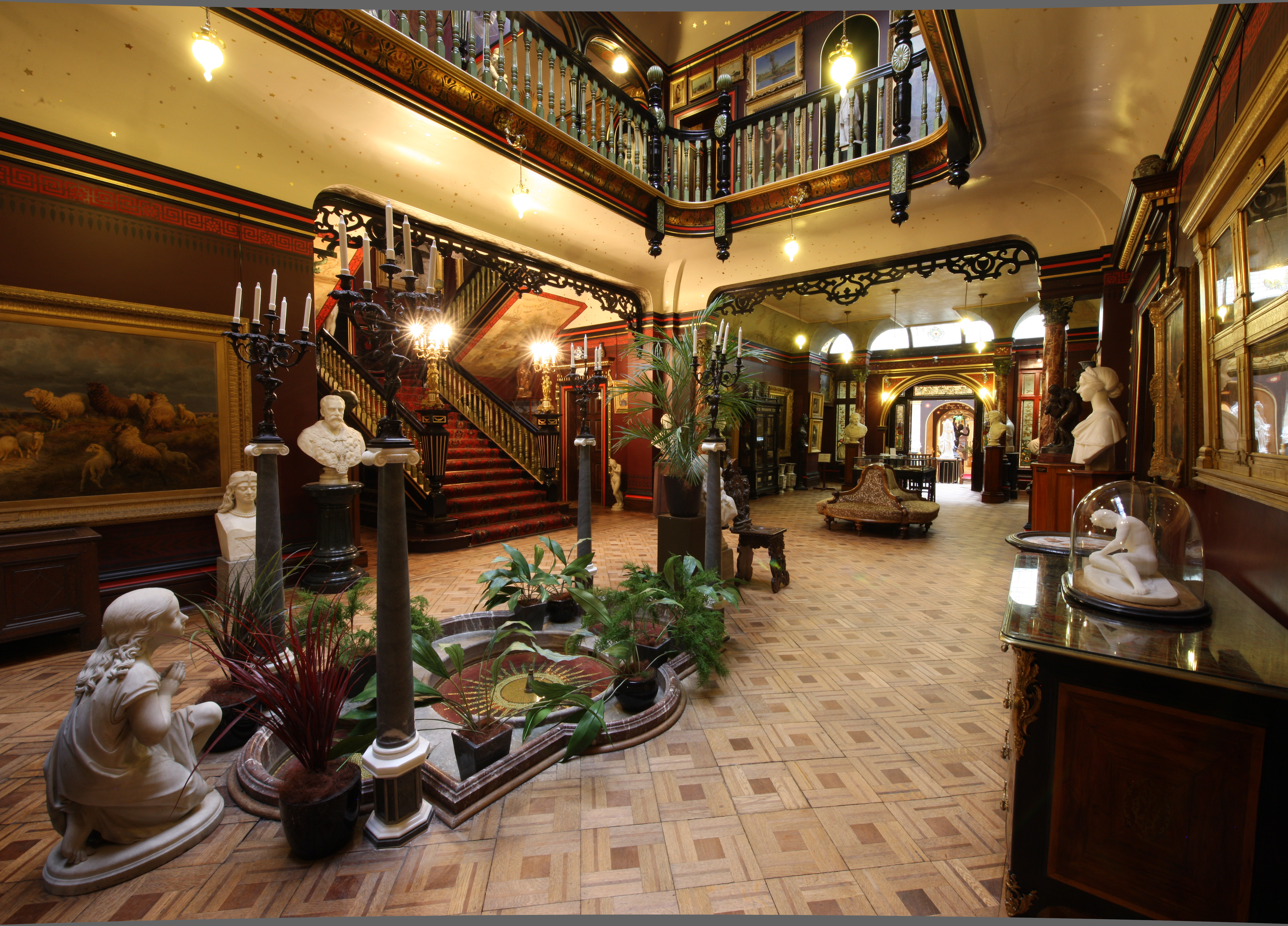
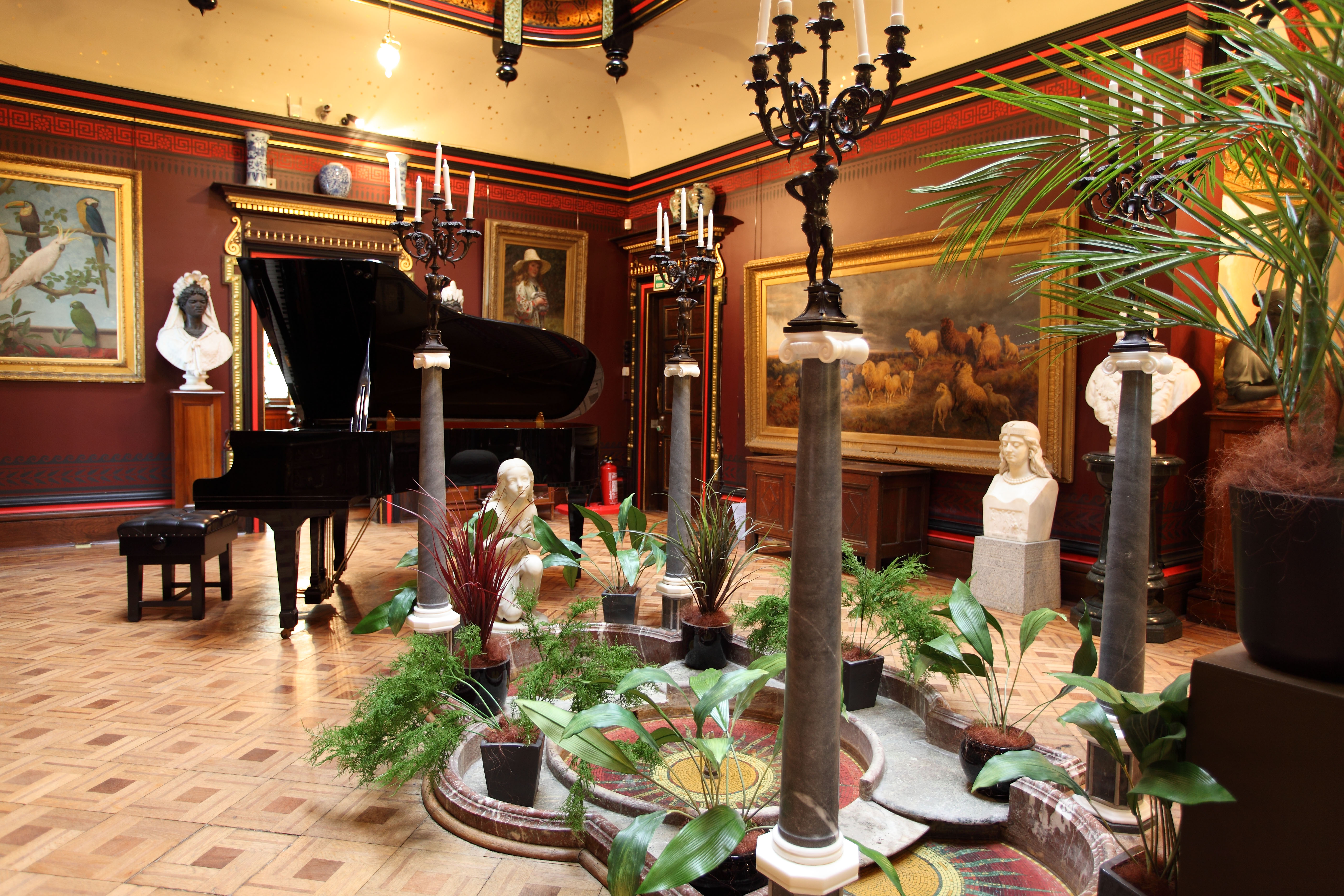
We plan to host the Illusion & Demo Night at the Russell Cotes Art Gallery & Museum . It is a historic Victorian seaside villa in Bournemouth filled with global art and collections, originally built as a private home and later donated to the public.
Program
Overview of our preliminary* conference schedule:
More information and download of program …
Please find the link to our programme below.
You can use the search function to browse all contributions and select the sessions you would like to attend.
Your selections can be saved locally, and you can also export them as an .ics file to add them to your calendar.
The file should be compatible with most calendar applications, including Google Calendar, Apple Calendar, and Microsoft Outlook.
Posters |
Talks
ECVP 2026 Scheduler App - same layout as for VSS2026
ECVP 2026 Scheduler App
Search and organise the entire ECVP 2026 programme on your phone.
Build a personal schedule and export it to your calendar — no app store, no account, no sign-up.
- All 622 keynotes, symposia, talks, posters & socials — full-text search
- Filter by day (Sun–Thu) and type
- Tap any card for the full abstract, authors and affiliations
- Build your own schedule and export it to Google Calendar
- Works offline after the first load — add it to your home screen
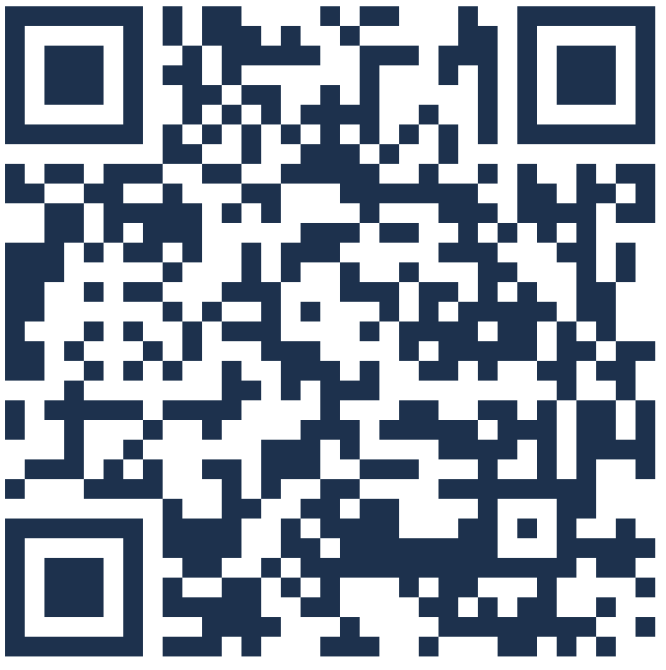
Scan to open the schedule app
https://markwgreenlee.github.io/ecvp-2026-scheduler
No app store needed — opens in any phone browser and works offline.
On iPhone use Safari, on Android use Chrome, then select “Add to Home Screen”.
Many thanks to Mark Greenlee, who developed the app and put the ECVP 2026 programme into the scheduler.
Conference venues
Main conference venues by Bournemouth Beach
- Poster sessions, talks and keynote talks and Welcome reception & coffee breaks @ Bournemouth International Centre
-
Illusion & Demo Night @
Russell-Cotes Art Gallery & Museum
- Conference Dinner (Aug 26th) @ Bournemouth Pavillion
- Farewell Party (Aug 27th) @ Key West at the Bournemouth Pier
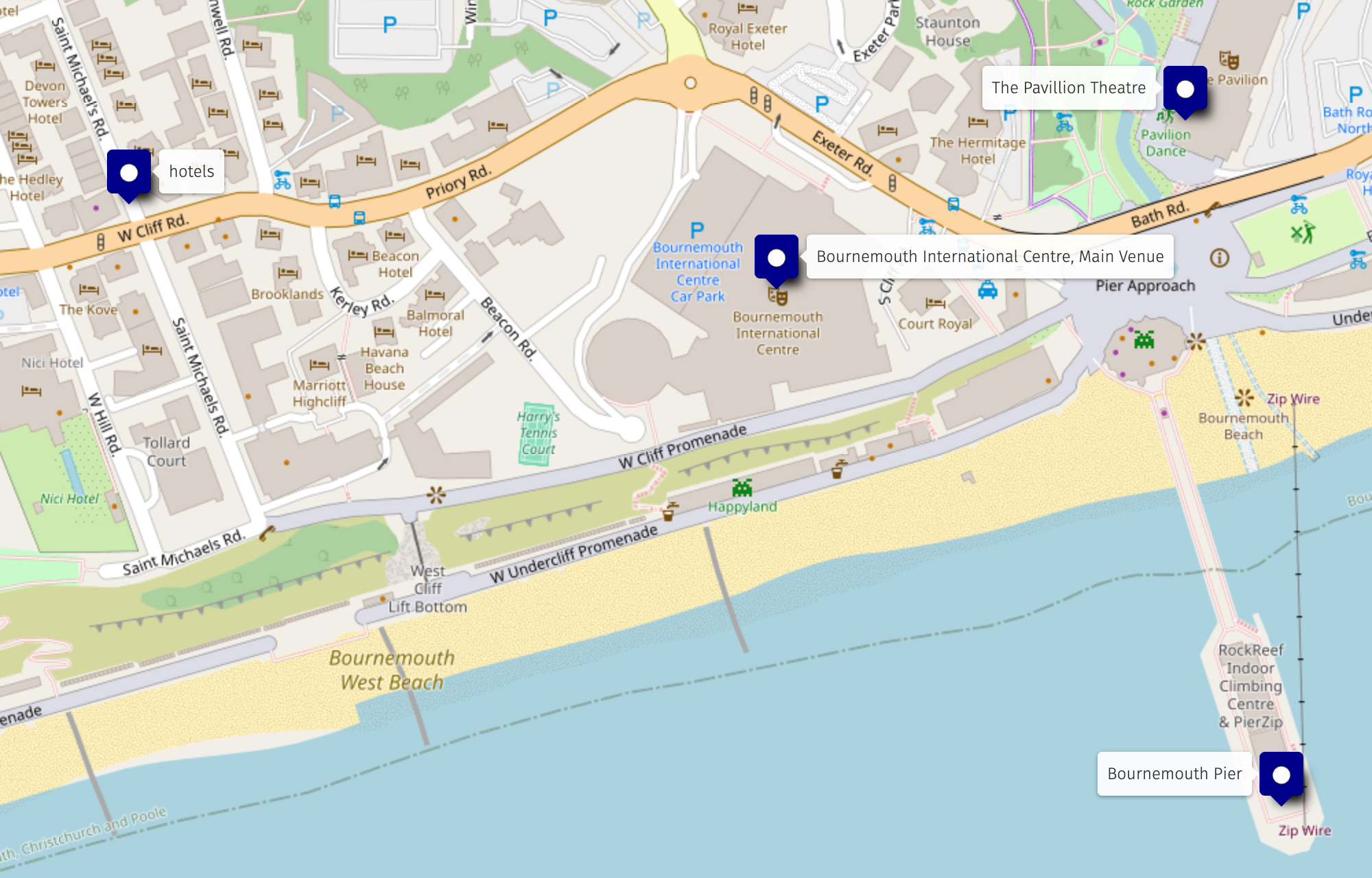
Bournemouth University Lansdowne Campus for workshops.
Keynotes
We are thrilled to have secured three exceptional scientists as keynote speakers for ECVP 2026:
Perception Lecture
Karl Gegenfurtner
Justus Liebig University of Giessen
Aug 23rd @ Bournemouth International Centre (Solent Hall) | 18:00
Title: - Color Vision — Then and Now
Sponsored by: SAGE – Perception / i-Perception
Spotlight in Vision Lecture
Nadine Dijkstra
University College London
Aug 25th | 17:00 (Solent Hall)
Title: Distinguishing imagination from reality in a generative brain
Rank Prize Lecture
Monica Gori
Instituto Italiano di Tecnologia
.
Aug 26th | 17.00 (Solent Hall)
Title: The Early Role of Vision in Multisensory Development
Sponsored by: Rank Prize
Perception Lecture – Karl Gegenfurtner - Color Vision — Then and Now –
Abstract:
Many of the central questions in color vision have been with us for more than a century: How precisely can we discriminate colors? How stable are surface colors under changing illumination? And how should brightness and luminance be related to perception? This long tradition has produced a remarkably solid framework of theories, measurements, and standards. Yet its very success can also create the impression that the central questions have largely been settled. In this lecture I will argue that several classical problems in color vision remain surprisingly open. My current work revisits these questions using a new generation of experimental tools. Virtual reality allows color constancy to be studied in photorealistic scenes under nearly natural viewing conditions while maintaining full experimental control. Deep neural networks provide end-to-end models of vision that link color processing directly to tasks such as object recognition. Robust ranking paradigms enable large-scale online experiments to evaluate photometric standards and heterochromatic brightness. Finally, gamified tasks make it possible to measure color discrimination at unprecedented scale, helping to overcome the curse of dimensionality in color space. It is an exciting time in vision research, when new techniques allow us to find new answers to very old questions.
Spotlight in Vision Lecture – Nadine Dijkstra - Distinguishing imagination from reality in a generative brain –
Abstract:
Our perception of reality is generative: to resolve ambiguous sensory input, our brain predicts the most likely interpretation using an internal model built on past experiences. This same mechanism allows us to generate sensory signals in the absence of input, giving rise to mental imagery. Since perception and imagery rely on the same generative mechanism, how do we know at any given moment that what we are experiencing is real and not just imagined? I will present studies that aim to answer this question using psychophysics, neuroimaging and computational modelling. The results suggest that higher-order brain regions monitor the precision of sensory signals to infer whether they reflect reality or imagination. I end by discussing a novel research direction in which we will explore the interaction between reality inferences and our internal model of the world.
Rank Prize Lecture – Monica Gori -The Early Role of Vision in Multisensory Development –
Abstract:
Developmental processing relies heavily on vision, which serves as a key organizer for integrating information from other senses. Vision indeed helps to shape how auditory and tactile signals are interpreted, supporting the development of coherent spatial and body representations. When visual input is missing early in life, as in blind infants and children, these representations are often altered, leading to difficulties in multisensory integration. Understanding how vision guides early sensory interaction reveals its foundational role in building a unified perception of the world and informs the design of accessible technologies that translate visual information into sound, vibration, or movement.
Symposia
Our symposia offer a diverse selection of research topics, featuring speakers from various career stages, research backgrounds, and global locations to encourage lively discussion and exchange of ideas. A symposium should provide a diverse overview of a research area of interest to the ECVP audience. Organizers should strive to include speakers from different career stages, research groups, and geographic locations who represent a broad range of views and ideas under the overarching theme of the symposium. Presentations should be related to each other and stimulate insightful discussion. The symposium schedule will be announced near the conference.
Please find more information about our submission guidelines on the Submissions page.
Symposium submissions are complete. For a detailed list of all symposia, including the preliminary schedule of speakers, please expand the item below.
LIST OF SYMPOSIA:
1) The rhythmic nature of perception and attention: Evidence, challenges, and open questionsOrganiser: Maëlan Q. Menétrey
- Xiaoyi Lium, Michael Arcaro, & Sabine Kastner: Dynamic modulation of endogenous attentional sampling under cue uncertainty
- Maëlan Q. Menétrey, Paola Biocchi, & David Pascucci: Testing oscillatory modulations in temporal summary statistics across visual features
- Laurie Galas, Mehdi Senoussi, Niko Busch, Ian Donovan, Sanne ten Oever, & Laura Dugué: Oscillatory dynamics of attention in sensory tuning and perceptual processing
- Domenica Veniero, Francesca Nannetti, & Gregor Thut: Effects of neural oscillations on visual performance during attentional deployment
- Clare Press, Aaron Kaltenmaier, Quirin Gehmacher, & Matthew H. Davis, Peter Kok: Integrating fixed and flexible rhythms
2) Beyond local features: Spatiotemporal structure in perception and neural processing
Organisers: David Pascucci & Michael H. Herzog
- David Pascucci & Árni Kristjánsson: Seeing the trees through the forest: Spatiotemporal routines in visual cognition
- Steven Scholte: Binding for whom? From features and observers to action in a structured world
- Michael H. Herzog: A half second of spatiotemporal, contextual processing precedes conscious perception
- Lucia Melloni, Simon Henin, & Charan Ranganath: From local features to event structure: Surprise, prediction, and the dynamics of contextual vision
- Laura Dugué, Yue Kong, Kirsten Petras, David M. Alexander: Traveling Waves as spatiotemporal neural mechanism for perception and attention
3) What vision scientists can learn from continuous movement tracking during decision making
Organiser: Elahe’ Yargholi
- Tijl Grootswagers, Genevieve L. Quek, & Manuel Varlet: Movement trajectories reveal the connection between emerging neural representations and dynamic decisions
- Timothée Maniquet, Huangxu Fang, N. Apurva Ratan Murty, & Hans Op de Beeck: Predicting categorisation motor movements from cortical category selectivity
- Elahe’ Yargholi, Timothée Maniquet, Joost Vennekens, Jan Van den Stock, & Hans Op de Beeck : Continuous movement tracking during decision making regarding visual scenes reveals the competition between scene and people valence
- Maximilian P. Wolkersdorfer, & Omar F. Jubran: Introduction to Spatiotemporal Survival Analysis: New insights from distribution analyses of movement trajectories
- Omar F. Jubran, Jia Li, Maximilian P. Wolkersdorfer, Thomas Schmidt, Cees van Leeuwen, & Thomas Lachmann: Modelling Hand Movement Trajectories in Rapid Chase
4) Vision on the Move: From Eye Movements to Visual Encoding (and back)
Organisers: Antonella Pomè and Alessandro Benedetto
- Alessandro Benedetto, Michele A. Cox, Jonathan D. Victor, & Michele Rucci: Oculomotor contribution to synchronization of cortical activity
- Nina M. Hanning, & Martin Rolfs : From monocular input to binocular action: How pre-saccadic motion shapes post-saccadic following
- Antonella Pomè; & Eckart Zimmermann: Feedback and feedforward contributions to perceptual stability during self-motion
- Cristina de la Malla, & Martina Poletti: Temporal dynamics of visual processing during the course of fixation
5) Probing the Visual System: Illusions as Windows into Typical and Atypical Cognition
Organisers: Erez Freud & Elisabeth Hein
- Erez Freud: Atypical Development Disrupts the Perception-Action Dissociation: Evidence from Visual Illusions
- Batsheva Hadad: Altered Magnitude Matching Between Sensory modalities in Autism
- Elisabeth Hein: Ambiguous apparent motion perception in 5–7-year-old neurotypical children
- Irene Sperandio: Stress and visual illusions: Is there a relationship?
6) Visuomotor transforms in prostheses, virtual reality, and teleoperation
Organiser: Emily Crowe
- Simon Watt & Molly Hewitt: : Grasping with altered hands: (why) are some sensorimotor transformations more intuitive than others?
- Loes van Dam & Celine Honekamp: Adapting to sensorimotor delays in continuous motor control tasks
- Emily Crowe, Gift Odoh, John Kiran, Raul Ghisa, Daniel Torres Ruiz, Harun Tugal, & Ayse Kucukyilmaz: Learning novel visuomotor mappings in remote control
- Peter Scarfe, Rea Gill, & Chloe Irwin : Sensorimotor transforms and teleoperation in the nuclear industry
7) Perception as Inference Across Scales — from natural scene statistics to neural computation and clinical translation
Organisers: Guido Maiello & Veronica Pisu
- Erich Graf, Wendy Adams, & James Elder: : SYNS: A Decade of Natural Scenes for Perception Science
- Charles Leek, Filipe Cristino, & Dietmar Heinke: The Integration of Shape Information Across Spatial Scales during the Visual Perception of 3D Object Geometry: Evidence from Deep Neural Networks, ERPs and Eye Tracking
- Arezoo Pooresmaeili, Nathan Huneke, & Guido Maiello: Reward Learning Reshapes Neural Representations of Visual Perception and Imagery
- Christoph Witzel: Colour Inference in the Wild: #theDress Ten Years On
- Veronica Pisu, Aleksandrs Koselevs, Sarah Cutler, Maria Patsiamanidi, Sam Khandhadia, Isabel Escofet, Jay Self, Andrew Lotery, & Guido Maiello : Continuous Psychophysics in the Clinic
8) Strategies for searching: better understanding visual foraging through the study of individual differences
Organisers: Anna E. Hughes & Jérôme Tagu
- Ian M. Thornton & Árni Kristjánsson: : Foraging tempo revisited: How does time pressure contribute to individual differences in target selection behaviour?
- Maha Haggouch, Karine Doré-Mazars, & Jérôme Tagu: How working memory shapes visual foraging behaviour: insights from individual differences
- Sarah K. Salo, Matthew E. Roser, & Alastair D. Smith: Immersive virtual reality for probing visual foraging across the lifespan
- Manjiri Bhat, Daniel Smith, Alexis Cheviet, Anna Hughes, & Alasdair Clarke: Visual foraging patterns as distinguishing features: A predictive model for PSP vs. Parkinson's Disease
9) Recent Advances in Face Perception and Identification: From Cells to Cognitive Mechanisms and Applied Identification
Organisers: Alejandro J. Estudillo & Christel Devue
- Bruno Rossion, Marie-Alphée Laurent, Jacques Jonas, Sophie Colnat-Coulbois, Laurent Koessler, & Corentin Jacques: : The cellular basis of the human face inversion effect
- Louise Ewing, Inês Mares, Rachel Bennetts, Sarah Bate, Nadja Althaus, Michael Papasavva, Emily K. Farran, & Marie L Smith: 2. A cross syndrome investigation of face selective processing abilities in Williams Syndrome and Down syndrome
- Anna Bobak: Predictors of lineup accuracy in 2D and 3D displays: An individual differences approach
- Christel Devue, Morgan Reedy, Gamze Ceylan and Mariame Bourard: Context-induced distinctiveness in face learning: Evidence across multiple facial appearance cues
- Alejandro J. Estudillo, Olivia Dark, Jan Wiener, Sarah Bate: 5. Navigating toward domain-specific accounts of face identification: evidence from individuals with developmental prosopagnosia and super-recognizers
10) Artificial Intelligence as a Window into Material Perception: From Minimal Models to Active and Individualized Representations
Organisers: Masataka Sawayama, Filipp Schmidt
- Arash Akbarinia, Alban Flachot, Matteo Toscani, & Raquel Gil-Rodriguez : : Spatiochromatic Representation in Discrete Autoencoders
- Anna Metzger & Matteo Toscani: Unravelling constancy mechanisms in haptic perception of materials using DNN modelling
- Takuma Morimoto, Arash Akbarinia, Katherine R. Storrs, Jacob R. Cheeseman, Hannah E. Smithson, Karl R. Gegenfurtner, & Roland W. Fleming: Tiny convolutional neural networks reveal computations underlying human gloss perception
- Masataka Sawayama: Personalized Modeling of Material Perception in Autism Spectrum Disorder
- Vincent Graham, Chenxi Liao, & Bei Xiao: Active Perception of Real-World Materials Using 3D Gaussian Splatting
Workshops
On Sunday, August 23rd, a series of hands-on science skill workshops will be held on the Bournemouth University Lansdowne Campus .
LIST OF WORKSHOPS:
These workshops will be running in parallel from 10.00 to 12.30:
Register for a Morning Workshop
Advanced stimuli presentation using Tobii Pro Lab and/or other third-party software (Room: BG306)
Organizer: Tobi
In this Tobii workshop, we will go through the process of setting up advanced stimulus presentations using different software options tailored to the task. Using the tools we have, we will define some example eye tracking setups that can be done using our own advanced screen project and others using tools like our SDK, the Titta toolbox, and Psychopy..
At the heart of behavioural research: Testable, Testable Magic, and Testable Minds (Room: BG116)
Organizer: Testable
This workshop centres on Testable, the all-in-one platform that has quietly become the default research and teaching tool for many behavioural and vision scientists across leading universities. No scripting, no complicated interfaces or experiment trees - just a clean way to design, deploy, and analyse experiments and surveys. We will begin by showing how researchers can build pretty much any study in Testable, covering stimulus presentation, timing control, response collection, randomisation and so on. We will then introduce Testable Magic, our AI-powered design assistant that lets researchers build working experiments through natural-language conversation. Finally, we will demonstrate Testable Minds, our integrated pool of verified participants worldwide, including the safeguards we have developed against AI-based fraud and bot participation. Attendees are encouraged to bring their own laptops to build and run their first study during the session, and to converse directly with Testable Magic. After this workshop, you should be able to build any behavioural experiment in under an hour - and most of your studies in 10–15 minutes. Free chocolate will be provided to all attendees.
All attendees will receive a free month of Testable Magic to use after the workshop
You should program your statistical models in Stan. It is easier than you think, and I’ll show you how.
Organizer: Alexander Pastukhov (Otto-Friedrich-Universität Bamberg)
In our research, we constantly rely on statistical models. Multiple R and Python packages provide models of various complexity from a basic t-test to generalized linear mixed models. However, they are limited in their design structure and flexibility of models that you can use. In this workshop, I will introduce an alternative approach of programming a statistical model from scratch using Stan probabilistic programming language. I will introduce syntax and walk you through an example of programming a basic two-group/condition comparison (a.k.a. a t-test), showing how it can be extended to allow for different distribution families, regularization. Next, I will show how Stan simplifies working with interactions using a two-way ANOVA. Finally, I will explain the underlying mechanisms of the MCMC engine, its limitations, how to diagnose the problems and ways to side-step them.
This workshop is aimed at a broad audience and requires basic knowledge of statistics and programming (either R or Python). Its aim is to introduce a flexible method that allows to program virtually any statistical model that you are interested in.
Prerequisite Knowledge:
- Basic knowledge of R or Python
- Basic understanding of statistics
Prerequisite Materials:
- R + RStudio + cmdstanr package. Your choice of packages for data wrangling and visualization, e.g., Tidyverse.
- or
- Python + cmdstanpy package. Your choice of packages for data wrangling and visualization, e.g., pandas + numpy + matplotlib/seaborn.
From image statistics to perception: Dead Leaves as controlled naturalistic stimuli (Room: BG115).
Organiser: Swantje Mahnck (TU Darmstadt)
In vision science, we often want to capture the complexity of natural images while retaining control over the scene. Dead leaves images provide a controlled intermediate step between simple laboratory patterns and fully natural images. They are generated by sequentially layering simple shapes, or leaves, sampled from parameterized distributions. The resulting images are cluttered and capture key statistical regularities of natural scenes. In this workshop, we introduce applications of dead leaves stimuli in vision research, such as cue combination in perceptual organization, natural image statistics, and image segmentation. At the core of the workshop, we show you how you can use the open source deadleaves Python package to generate a range of cluttered dead leaves stimuli.
Prerequisites:
- Attendees should bring a laptop to fully participate.
- To get the most out of the workshop, we recommend having Python 3.12+ installed, along with deadleaves and its dependencies.
- The installation instructions from deadleaves.readthedocs.io should cover the usual setup.
These workshops will be running in parallel from 14.00 to 16.30:
Register for an Afternoon Workshop
Hands-On Multimodal Eye Tracking and EEG Setups with Tobii and Brain Products (Room: BG306)
Organizer: Tobi
In this workshop Tobii has partnered with Brain Products to present a comprehensive, step-by-step guide on setting up multimodal systems. We will cover how to design an experiment with EEG in mind, configure synchronization options using Pro Lab and the USB to TTL box from Brain Products, and record an experiment using this setup. Additionally, we will provide a complete analysis pipeline for the data produced.
Reproducible research reports with Quarto (Room: BG115)
Organizers: Eline Van Geert & Lisa Koßmann – KU Leuven, Belgium
Are you conducting research that includes analyses performed in Python or R? Tired of manually copy-pasting the results from your analysis software to word processors like Word or LaTeX? Learn how to enhance the reproducibility of your work by creating reproducible research reports with Quarto. With Quarto, you directly combine text, code, and code outputs into custom formatted documents (including PDF/Word/HTML reports), articles, presentations, books, or websites. You can even add interactive elements to your documents to help readers explore your results.
In this workshop, we introduce participants to this versatile open-source scientific and technical publishing system. We discuss the basic components of creating a Quarto document, and demonstrate how to render it to different output formats. We also point you to additional resources for more complex uses of Quarto. If possible, please have one of the following editors installed before the workshop: Jupyter, Visual Studio Code, or RStudio (cf. https://quarto.org/docs/get-started/).
VR Foundations for Researchers in Experimental Psychology (Room: BG116)
Organizers: Markus Bindemann, Rachael Taylor and Lisa Huerta (University of Kent)
Virtual Reality (VR) systems have advanced rapidly in recent years. They now allow researchers to immerse participants in complex and increasingly realistic three-dimensional environments, while preserving the experimental control familiar from the laboratory. For example, modern VR supports the precise measurement of behaviour that is necessary for a wide range of research in experimental psychology, such as button presses, eye tracking, gesture recognition, and spatial position tracking, while visual and auditory stimuli can be presented with precise timing.
These capabilities place VR in-between the two dominant approaches in experimental psychology – highly controlled laboratory experiments and field studies. Laboratory experiments rely on carefully selected visual material, usually presented in isolation without extraneous background or social context, while field studies can provide insights that hold greater ecological validity, but relinquish systematic control over the many variables at play. VR provides an intermediate alternative to these traditional approaches by enabling the systematic study of human behaviour from within the confines of the laboratory whilst also capturing the realism of more complex environments and social interactions.
Despite its growing profile, the use of VR in psychological research still lags behind its technical potential. Many VR studies simply replicate traditional lab paradigms and fail to exploit the complexity and realism current systems can provide. It is easy to understand why these shortcomings arise, as the implementation of VR requires some new skill sets and fundamental changes to the way in which experiments are typically conducted. Although VR has been available for some time, most researchers lack training in its use and the technology can seem daunting.
The goal of this workshop is to bring together researchers who wish to adopt VR but are unsure how to begin. We will demonstrate the construction of virtual environments with Unity – a free cross-platform engine for creating 3D projects in virtual reality. We will then demonstrate how this can be turned into experiments that can be projected into a VR headset and record responses. The workshop attendees will receive detailed materials of these activities so that they can continue learning and adopt these methods independently.
Cambridge Research Systems. Choosing the right tool for the job. Techniques for precise stimulus presentation and accurate measurements of responses. (Room BG307)
Organizer: Cambridge Research Systems
You programmed your experiment to present specific stimuli at a precise time while collecting your participants’ responses. How do you know if your stimuli will be faithfully reproduced? How do you know if they will be presented at the intended time? How do you know if your participants’ responses will be recorded with accuracy and precision? During this workshop we will examine the relationship between the intended stimulus presentation and the actual visual and auditory output, then verify its accuracy using a variety of appropriate instruments. We will also demonstrate techniques to synchronise visual and auditory stimulus presentations with eye movements and reaction times. Using Psychtoolbox and equipment provided by Cambridge Research Systems, you will make measurements and compare results obtained on different computers to learn how to choose the right tools for your next experiment. Benefits: Attendees will be able to: (1)Plan the appropriate stimulus given the equipment available. (2)Verify if the actual stimulus reproduction matches the intended stimulus. (3)Understand mismatches between the intended stimulus and actual stimulus reproduction and make alternative plans.
Benefits:
- Plan the appropriate stimulus given the equipment available.
- Verify if the actual stimulus reproduction matches the intended stimulus.
- Understand mismatches between the intended stimulus and actual stimulus reproduction and make alternative plans.
Intended audience:
- Those who wish to understand how to select appropriate stimuli that can be faithfully reproduced with their existing equipment.
- Those interested in generating and presenting synchronous multimodal stimuli on computer-controlled displays.
Illusion & Demo Night
On Tuesday, August 25th, Illusion & Demo Night will showcase fascinating visual phenomena and interactive demonstrations in the beautiful setting of the Russell-Cotes Art Gallery & Museum in Bournemouth.
LIST OF DEMOS AND ILLUSIONS:
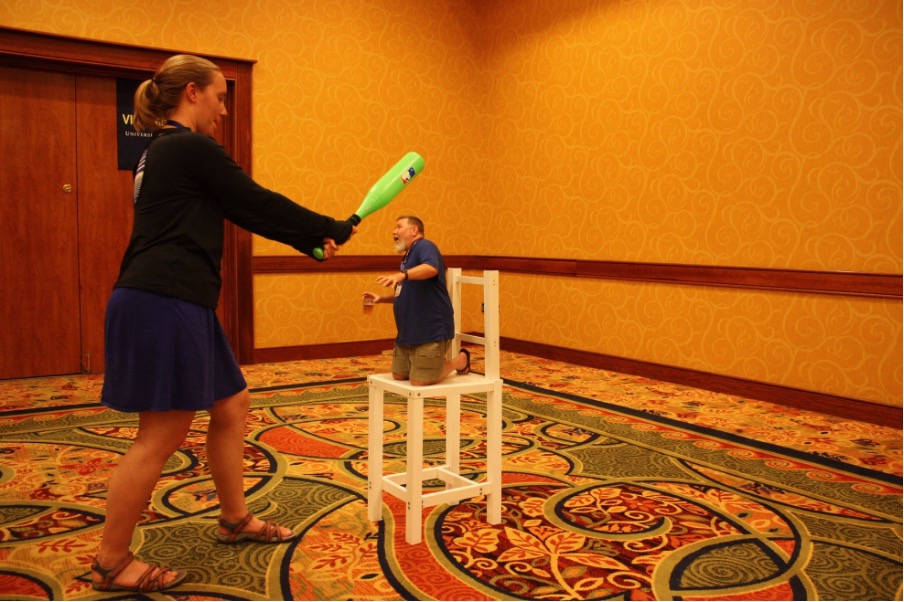
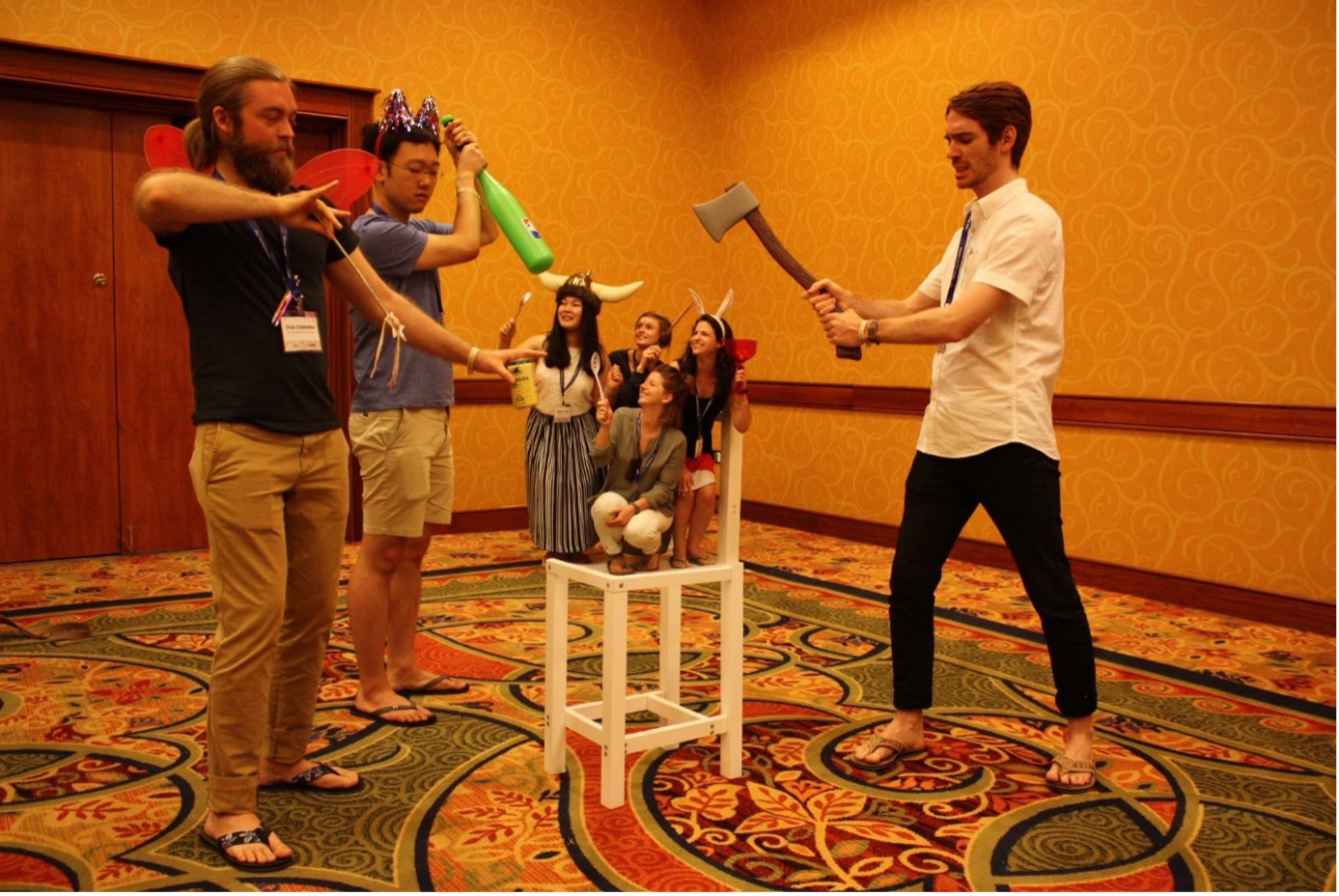
Beuchet Chair
Peter Thompson
A great favourite at all conferences, the Beuchet chair illusion was created by psychologist Jean Beuchet in 1963. An oversized chair seat and backrest is positioned several feet behind the standard-sized chair legs. Viewed from a specific angle, the seat and back fuse with the legs into one regular chair, making anyone sitting on the seat appear disproportionately tiny – or anyone standing by the legs appear huge!
Patrick Hughes’ Ames Door and Solid Hollow - Art meets Perception
Brian Rogers and Patrick Hughes
Seventy-five years ago, Adelbert Ames (1951) created his trapezoidal-shaped Ames Window which rotates continuously around a vertical axis but appears to oscillate back-and-forth. Seventy-five years later, the artist Patrick Hughes created a new variant - the Ames Door - which rotates continuously around a vertical axis but appears to oscillate back-and-forth. We suggest that you compare the appearance of the Ames Door when it is viewed from either several meters away or more closely, from <50 cm. Also, try viewing the Ames Door with either one eye or two (i.e. monocularly or binocularly). Is there a difference? What does this tell us? Patrick Hughes’ second artwork Vertical and Horizontal is a Solid Hollow in which the physical structure is hollow (concave) but appears to stand-out (convex) from the background (unless the artwork is viewed from a very close distance). Try approaching this artwork while swaying from side-to-side and you are likely to see the spines of the stack of books follow you with your own side-to-side movements. The unique feature of Vertical and Horizontal is that it is constructed so that it can be rotated (by us) around the observer’s line-of-sight. As a consequence, the spines of the stack of books can be oriented either horizontally (like a stack of books on a table) or vertically (like a row of books on a shelf). Why should the orientation of the books matter? When the spines of books are oriented vertically, they provide disparities that signal the true hollow structure of the artwork, whereas when the spines of books are oriented horizontally, they provide little or no disparity information. Try approaching Vertical and Horizontal while swaying from side-to-side until your perception “flips” from appearing convex to appearing concave. Does the “flipping” point vary depending on whether the spines are oriented either vertically or horizontally.
Huh, which direction?
Rob van Lier & Vebjørn Ekroll
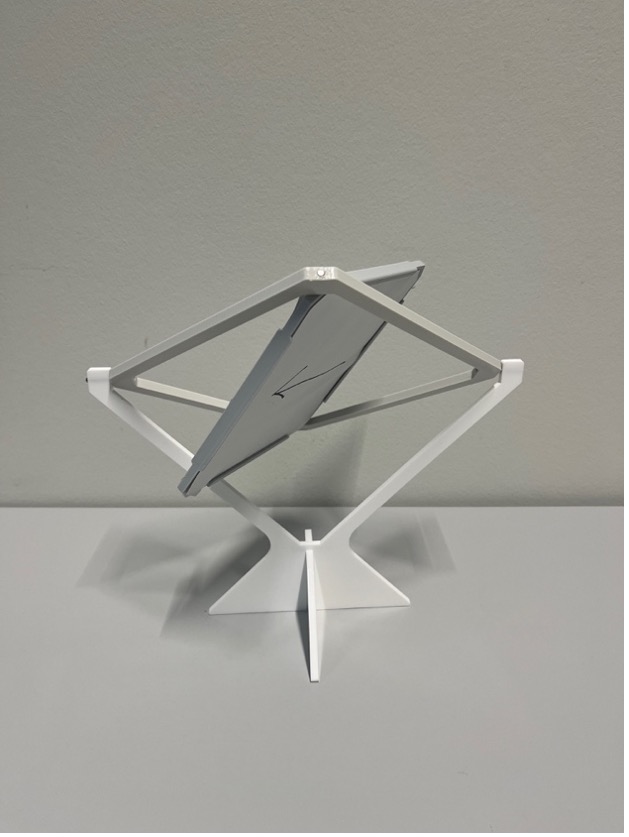
We present an extremely simple, yet incredibly challenging, mental task. Our demo setup comprises a specially designed installation with a rotating surface. Observers are asked to predict the position of a pointing arrow after a specific rotation. Pilots show that observers are mostly puzzled by the actual outcomes. Informal chats revealed that they even perceive this as a magic trick involving some hidden manipulation. Obviously, this is not the case. Or is it?
Size Weight illusion
Eli Brenner
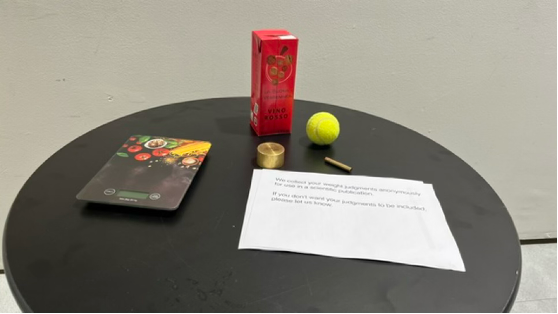
People consistently overestimate the weight of small objects with respect to large ones. In this demo, we will let conference attendees experience this by lifting pairs of objects of different sizes. For each pair, we will ask them to judge how heavy one of the objects is, given the known mass of the other object. We will then reveal the correct answer, allowing them to check it by placing the objects on a kitchen scale.
The illusion of absence: A common factor in magic tricks and road accidents involving obstructions of view?
Pierre-Pascal Forster, Melika Miralem, Rob van Lier & Vebjørn Ekroll
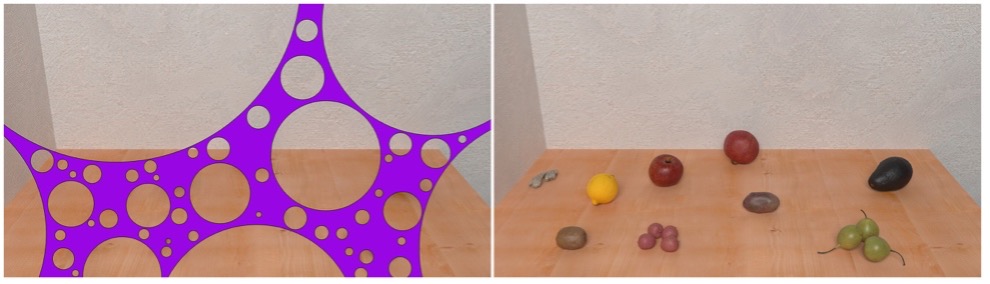
We show several demonstrations of the illusion of absence, where the space behind an occluding object in the foreground looks compellingly empty, even when it is not. These demonstrations illustrate how this illusion is used in magic tricks to make things seem to levitate or appear out of nowhere and also how the same illusion may play a role in road accidents involving obstructions of view, such as the pillar next to the windscreen.
Pictorial space crafts - the Ames’ glass.
Maarten Wijntjes
Over the past 300 years, various optical aids have been discovered that enhance the experience of depth in single pictures. The development started with fixed-viewing distance devices such as the zograscope and graphoscope and later variable-distance devices such as the synopter were invented. About 100 years ago Ames discussed these devices, which we will call pictorial space crafts, including a particular cylindrical lens. Yet, the actual depth effect of the lens was never documented. We investigated the effect of weak cylindrical lenses placed in front of one eye, while the other eye receives an undistorted signal. The effect turned out to be as remarkable as previous pictorial space crafts: pictorial plasticity is enhanced in a way that many observers find surprising. We will not go into detail about the effects so that you can enjoy it yourself with (quasi-)naive eyes.
The Baby Groot Illusion
Ian. M. Thornton, Anna Riga, Sunčica Zdravković & Dejan Todorović
Typically, when we look directly at an object or scene, we would expect that to be more revealing than when we view it peripherally. However, this is not the case for a number of well-known dynamic visual illusions – such as the furrow (Anstis, 2012), curve-ball (Shapiro et al., 2010) and double-drift (Lisi & Cavanagh, 2015) illusions – where effects are absent or reduced when viewed foveally. Here, we provide another example in which this central-peripheral viewing discrepancy is particularly strong. Just as Baby Groot stopped dancing whenever Drax looked directly at him in the classic, mid-credit “Guardians of the Galaxy, Vol. 1” scene, here we present a new dynamic display where a sedately rotating windmill viewed centrally turns into a wildly gyrating party animal when viewed peripherally.

An introduction to Dynamic Illusory Waves (Diwas)
Ian. M. Thornton, Sunčica Zdravković, Anna Riga & Dejan Todorović
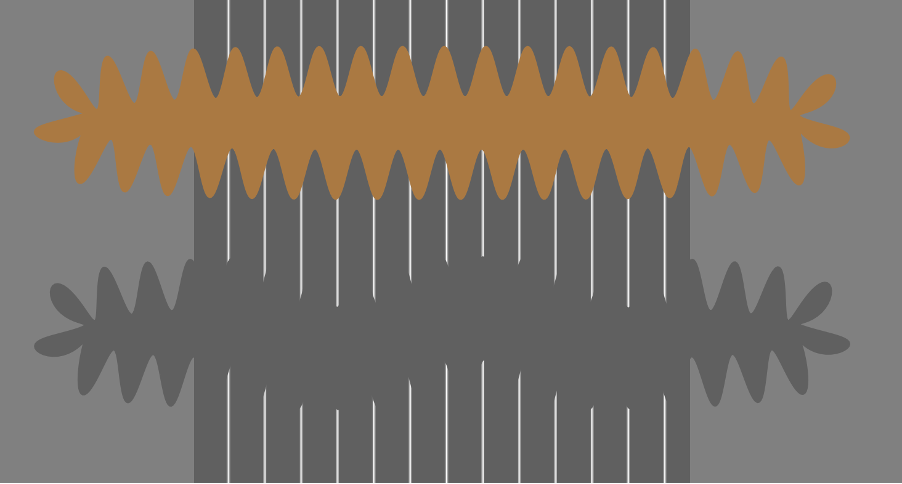
We present a new illusory display in which two physically drawn components – a shape with a sinewave-modulated contour and a regular “pinstripe” grating– give rise to a third phantom component in the form of a complex, non-rigidly deforming wave. The form of the dynamic illusory wave (diwa) is primarily determined by the spatial frequency ratio between the physically drawn components. Local phase differences at points of intersection define a subjective contour, which in turn gives rise to an illusory surface. When relative motion is added –by temporally modulating the borders of the physical shape, drifting the grating or simply moving a static shape across the grating – a non-rigidly deforming illusory wave is generated and appears as a transparent occluding surface. Here in the static illustration, we reveal the basic outline of the diwa by redrawing the upper shape in the same gray as the grating background. In the illusion –once motion is added – the shape and the wave appear superimposed.
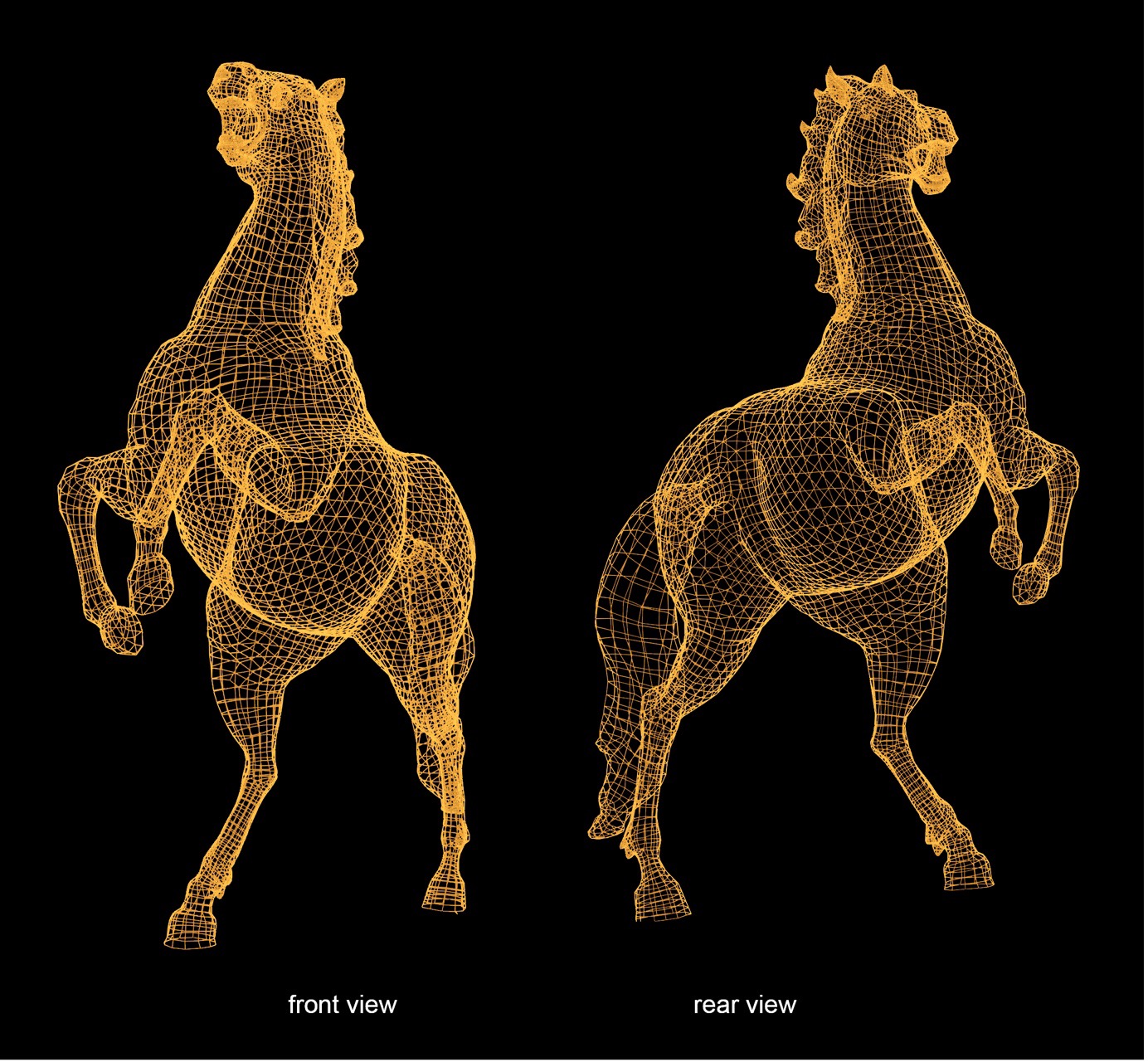
Rotating wireframe figures
David Phillips
Wireframe figures offer an opportunity to explore the Hollow Face Illusion in greater depth - literally. In the usual illusion, the mask of a face rotates so as to present a hollowed out face seen from the back, but the brain cannot accept the features as concave. Instead we see both the inside and outside of the mask as normal, convex faces, and with the reversal from concave to convex the apparent direction of rotation of the mask also changes. The transparent wireframes in this movie present similar effects not only with faces but with whole creatures. Some extend into considerable depth, and the reversals from hollow to solid then also offer dramatic changes in apparent size. The reversals can be ambiguous, so that the creatures ‘flip’ from one view to another, or some parts of a creature can appear to reverse, whilst others do not. What is seen varies from one viewer to another. The effects offer a grandstand view of the brain struggling with baffled expectations and juggling probable solutions.
Strobe Hallucinations
Trevor Hewitt
Using a stroboscopic lighting setup, we induce visual hallucinations that are theorised to reflect low-level visual processing. When combined with music in a comfortable environment, the experience is like a cross between a meditation and a short psychedelic trip, enjoyed by both researchers and the general public alike.
Mind the Gaze!
Alexander (Sasha) Pastukhov
Gazing around is such a natural and effortless process that we rarely stop to wonder how many hidden rules keep this “effortless” system in check. Your eyes feel like superpowers — but they come with surprisingly strict user manuals. We present three playful demos that let you catch your visual system in the act — and in its limitations. A “Laser Eyes” game will show that even a super man cannot draw a smooth circle with his (laser) eyes, unless he can follow a target in smooth pursuit. “Spot the polka dot” will remind you about saccadic suppression and your limitations is spotting changes in a visual scene. “Don’t look at me!” will show a tight link between attention and gaze that is harder to break than it feels. Come play, test your superpowers, and see how your vision quietly cheats, cuts corners, and tricks your perception.
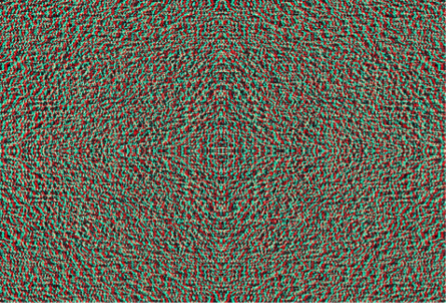
Anaglyphic art
Nicholas Wade
Anaglyphs are simple forms of stereoscopes: they provide a technique for presenting different patterns to each eye. They are displays in which the left and right eye images are printed or projected in different colours, such as red and cyan, and they are viewed through filters of the same colours so that each eye sees a different image. Anaglyphic art refers to pictures that require two eyes to see the depth or rivalry they carry. They reveal to two eyes what is concealed from each alone. Red/cyan viewers will be provided to see a wide range of novel anaglyphs designed to link the science and art of binocular vision.
Sixth finger illusion
Denise Cadete
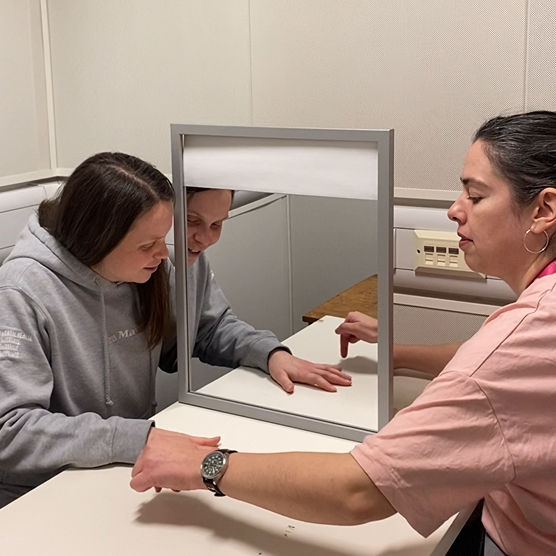
Can you feel like you have an extra finger? Or even a third arm? In this illusion, I will use mirrors and synchronous strokes on your hands to trick your brain into perceiving extra fingers or extra arms. You may feel the uncanny sensation of having an invisible extra finger or other unusual bodily sensations. This illusion shows how flexible the mind is in perceiving its own body, allowing us to experience, instantly and vividly, extra body parts that we do not have, and that do not exist in the human body plan. If you dare, you can also try some stranger variations of this illusion and experience what it’s like to have an extra finger with an implausible shape or size. Discover how easily you can experience extra parts of your body and what it feels like when the boundaries of your body extend beyond its real form.